• German
  • English
  • Warenkorb
  • Login/Benutzerkonto
Verlag Dr. Friedrich Pfeil
  • [avia_search]
  • Shop
    • Login/Benutzerkonto
  • Gesamtverzeichnis
  • Archäologie
    • Bücher
    • Reihen & Zeitschriften
    • Blickpunkt Archäologie
  • Biologie
    • Bücher
    • Reihen & Zeitschriften
    • Ichthyological Exploration of Freshwaters
    • Meiofauna Marina
  • Geographie
    • Bücher
    • Reihen & Zeitschriften
  • Geologie
    • Bücher
    • Kinderbücher Geologie
    • Reihen & Zeitschriften
    • Wanderungen in die Erdgeschichte
    • Münchner Geowissenschaftliche Abhandlungen Reihe B
  • Ökologie
  • Paläontologie
    • Bücher
    • Reihen & Zeitschriften
    • Münchner Geowissenschaftliche Abhandlungen Reihe A
    • Handbook of Paleoichthyology
  • Sonstiges
    • Philosophie
    • Romane
    • Volkskunde
  • E-Book (PDF) Bestellungen
  • Verlag
  • Buchhandel
  • Für Autoren
  • Kontakt
  • Menü Menü
  • Einkaufswagen Einkaufswagen
    0Einkaufswagen
  • Link zu Facebook
  • Link zu X

Suche

Search Search
Blick ins Buch:
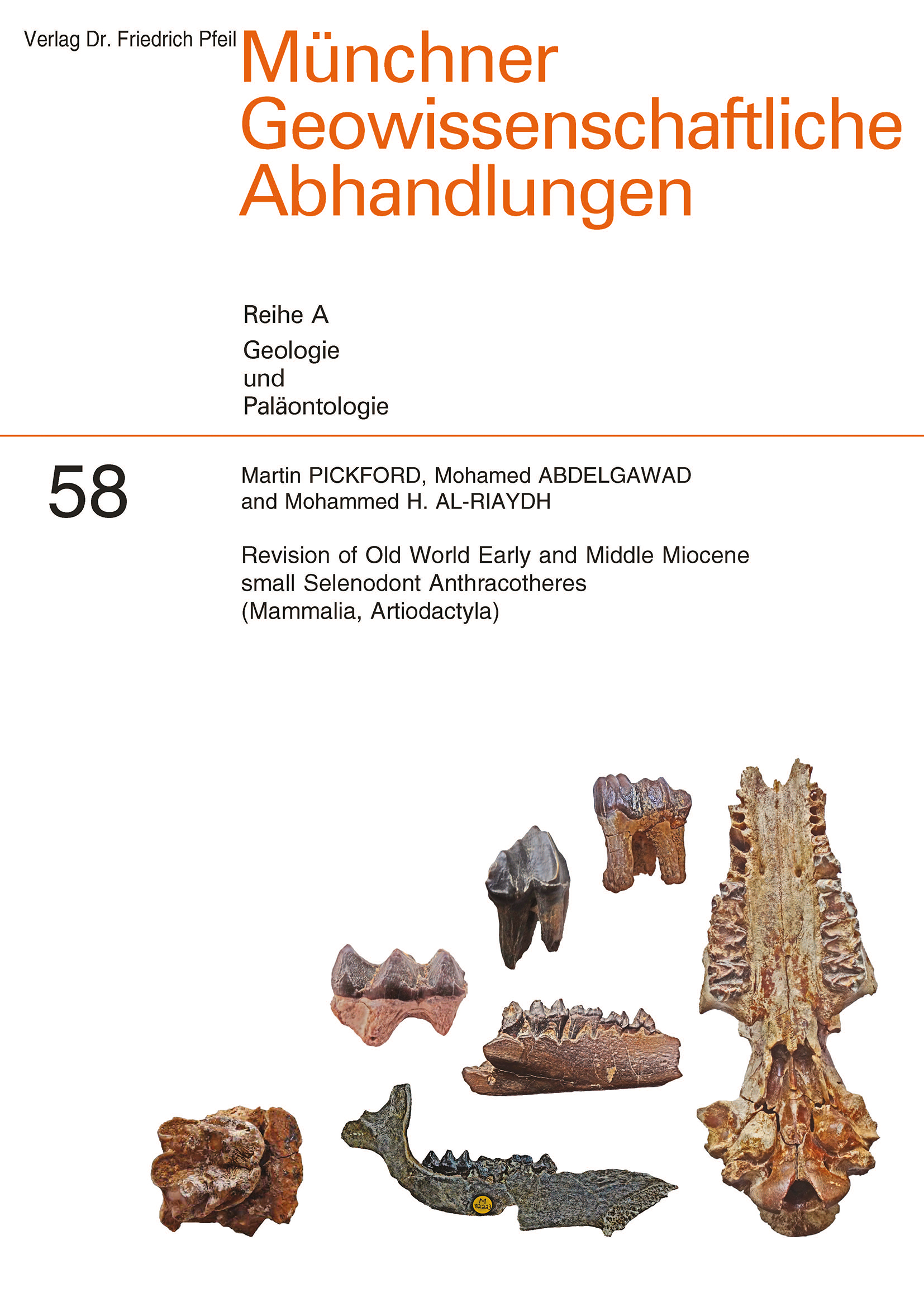
PICKFORD, Martin, ABDELGAWAD, Mohamed & AL-RIAYDH, Mohammed

Revision of Old World Early and Middle Miocene small Selenodont Anthracotheres (Mammalia, Artiodactyla)

Münchner Geowissenschaftliche Abhandlungen - Reihe A
Band: 58

2026. [Englisch] – 100 Seiten, 152 Farb- und 13 Schwarzweißabbildungen, 9 Tabellen.
29,7 x 21,0 cm, Paperback.

Reihe: MGA, Reihe A: Geologie und Paläontologie

Vorbestellung. Dieses Buch erscheint im August 2026.

ISBN: 978-3-89937-318-9
ISSN: 0177-0950
Artikelnummer: 9783899373189 Kategorie: Paläontologie Schlagwort: Münchner Geowissenschaftliche Abhandlungen - Reihe A

80,00 €

zzgl. Versandkosten / Versandkostenfrei in D

This monograph presents a comprehensive revision of the Early Miocene small anthracotheres of Africa, the Middle East, the Indian Subcontinent and Europe based on newly discovered and previously undescribed fossil material. Reassessment of cranial, mandibular and dental morphology demonstrates that several fossils formerly assigned to Sivameryx belong to distinct genera, leading to the resurrection of Merycops and the recognition of several new genera, including Prolibycosaurus, Maradameryx, Afromerycops and Libycomeryx. The study reveals that the diversity of small anthracotheres in the African Neogene has been substantially underestimated, with at least eleven genera now recognised and complex biogeographical links between Africa, Asia, the Levant and Europe. These taxonomic revisions provide a new framework for understanding the evolution, systematics and dispersal of small anthracotheres throughout the Old World during the Neogene.

  • Beschreibung
  • Zusammenfassung
  • Inhaltsverzeichnis
  • Kundenmeinungen
  • Rezensionsexemplar

This monograph presents the first comprehensive revision of the Early Miocene small anthracotheres of Africa and places them within a broader evolutionary and biogeographical framework by integrating evidence from the Middle East, the Indian Subcontinent and Europe. Based on extensive re-examination of historical collections together with newly discovered and previously undescribed fossil material from Moghara (Egypt) and Gebel Zelten (Libya), the study provides a fundamental reassessment of the taxonomy, systematics and diversity of these poorly understood artiodactyls.

For more than a century, many African small anthracothere fossils were referred to a limited number of taxa, particularly Sivameryx moneyi and Sivameryx africanus. Detailed analyses of cranial, mandibular and dental morphology presented in this volume demonstrate that these traditional assignments considerably underestimated the true diversity of the group. Comparative study of material from Africa, Pakistan, India, the Levant and Europe reveals that several previously recognised species represent distinct evolutionary lineages, necessitating extensive taxonomic revision.

The monograph resurrects the genus Merycops as distinct from Sivameryx and establishes the new genera Prolibycosaurus, Maradameryx, Afromerycops and Libycomeryx. It further reassesses the status of Afromeryx, Nacholameryx and other problematic taxa, providing revised diagnoses, systematic relationships and distributional data. The resulting classification recognises a substantially greater diversity of small anthracotheres in the African Neogene than previously appreciated, with at least eleven genera now documented from the Early Miocene of Africa.

Beyond its taxonomic contributions, the study offers important insights into the evolutionary history and palaeobiogeography of anthracotheres. It documents faunal connections between Africa, the Arabian Peninsula, the Indian Subcontinent and parts of Europe, while highlighting regional diversification and evolutionary innovation within the African record. The revised phylogenetic framework provides a more robust basis for interpreting dispersal patterns, lineage evolution and faunal exchange across the Old World during the Neogene.

Combining detailed systematic descriptions, comprehensive comparative analyses and high-quality illustrations of fossil specimens, this volume represents the most complete treatment of African small anthracotheres published to date. It provides an essential reference for vertebrate palaeontologists, mammalian taxonomists, evolutionary biologists and researchers interested in Neogene mammalian faunas and Old World biogeography.

By providing a revised systematic framework for one of the least understood groups of Old World anthracotheres, this monograph establishes a taxonomic foundation for future studies of Neogene mammalian evolution, palaeoecology and biogeography.
Dentognathic remains of small anthracotheres from the Early and Middle Miocene of Africa have traditionally been attributed to three species, Sivameryx africanus (Andrews, 1914), Sivameryx moneyi (Fourtau, 1918) and Afromeryx zelteni Pickford, 1991b, defined mainly on the basis of morphological data. The three taxa are roughly similar in size and this has complicated interpretation of some of the less complete or poorly preserved remains. Recently, a fourth species of comparable dimensions, Nacholameryx baragoiensis Tsubamoto, Kunimatsu, Tsujikawa et Nakatsukasa, 2025, was described from the basal Middle Miocene deposits of Nachola, Kenya.

Until 2014, small anthracothere remains from Moghara, Egypt, were consistently attributed to a single species, Sivameryx moneyi (which included a poorly preserved ‘variété’ named Sivameryx moneyi strictidentata (Fourtau, 1918)) but recent collections of mandibles and maxillae from the region reveal that the taxonomic diversity is greater than previously thought.

A similar underestimate of diversity affected the small anthracotheres from Gebel Zelten, Libya, with the fossils being attributed historically to two genera – Afromeryx zelteni and Sivameryx africanus – but access to undescribed collections in Paris and London, reveals that the diversity is appreciably greater than previously reported, there being five genera in the Libyan deposits, three of which are new.

These discoveries have necessitated a revision, not only of the Egyptian and Libyan material but also of all the Early and Middle Miocene small anthracotheres of the Old World, especially the material from Pakistan (Sind, Bugti). Fossils from other countries (India, Oman, Israel, Kenya, Uganda, Tunisia, Algeria, Turkey, Switzerland) were included in this study in order to develop a holistic overview of the small Early Miocene and Middle Miocene anthracotheres of the Old World.

Reassessment of the Indo-Pakistan fossils attributed in recent literature to the genus Sivameryx, reveals that it comprises specimens from two genera, one with a short diastema in the mandible between the lower canine and the p/1 (Sivameryx palaeindicus (Lydekker, 1877)) the other with a long diastema on which there is a small laterally everted process (Merycops longidentatus (Pilgrim, 1908)). The genus Merycops Pilgrim, 1910, is thus resurrected for the material attributed to Merycops longidentatus and for the Early Miocene African species?Merycops africanus Andrews, 1914.

Small anthracotheres are rare in the Early Miocene deposits of Europe, but they are represented at Benken, Switzerland (Stehlin, 1914; Scherler, 2011), one tooth from the site (a P4/) showing strong morphometric similarities to some of the specimens from Moghara, another (an upper molar) resembling species of the genus Elomeryx Marsh 1894.

This monograph presents the results of the investigation.

Key Words: Bothriodontinae, Early Miocene, Africa, Europe, Asia, taxonomy, systematics, palaeobiogeography,

Introduction 7
Indo-Pakistan small anthracotheres 9
Eastern Africa small anthracotheres 12
Geological Context, Age and Palaeoenvironment 12

Material and Methods 13
Institutional Abbreviations 13
Dental Nomenclature 14
Discussion 15

Systematic Palaeontology

I. Small Anthracotheres from Indo-Pakistan 16
Genus Sivameryx Lydekker, 1877a 16
Species: Sivameryx palaeindicus (Lydekker, 1877a) 17
Genus Merycops Pilgrim, 1910 18
Species Merycops longidentatus (Pilgrim, 1908) 19
Discussion 20

II. Small Anthracotheres from Gebel Zelten (Jabal Zaltan), Libya 22
Genus Merycops Pilgrim, 1910 22
Species Merycops wahatensis nov. 22
Genus Afromerycops nov. 29
Species Afromerycops libycus nov. 30
Genus Afromeryx Pickford, 1991b 33
Genus Libycomeryx nov. 37
Species Libycomeryx sirtensis sp. nov. 37
Genus Maradameryx nov. 40
Species Maradameryx maradensis (Gaziry, 1987a) 41
Metric Analysis 45

III. Small Anthracotheres from Moghara, Egypt 47
Genus Sivameryx Lydekker, 1877a 47
Species Sivameryx moneyi (Fourtau, 1918) 47
Subspecies Sivameryx moneyi variété strictidentata (Fourtau, 1918) 52
Genus Merycops Pilgrim, 1910 53
Species Merycops africanus Andrews, 1914 53
Species Merycops wahatensis Pickford, AbdelGawad & Al-Riaydh (this volume)  62
Genus Afromeryx Pickford, 1991b 65
Species Afromeryx zelteni Pickford, 1991b 65
Genus Prolibycosaurus nov. 67
Species Prolibycosaurus qattaraensis nov. 67
Metric Analysis 76

IV. Small Anthracotheres from diverse Localities in Tropical Africa, Asia and Europe 77
Karungu, Kenya 77
Kalodirr, Kenya 77
Ombo, Kenya 79
Kakara, Uganda 82
Ghaba, Oman 82
Kamus Junction, Arabian Peninsula 83
Palasava, India 85
Pasuda, India 85
Bugti, Pakistan 86
Benken, Switzerland 86
Sigircili, Turkey 87

General Discussion 89
Biostratigraphic Implications 89
Palaeobiogeographic and phylogenetic Implications 90
Conclusions 91

Acknowledgements 91

References 92

Annex 1 95

Annex 2 98

Rezensionen

Es gibt noch keine Rezensionen.

Schreiben Sie die erste Rezension für „Revision of Old World Early and Middle Miocene small Selenodont Anthracotheres (Mammalia, Artiodactyla)“ Antwort abbrechen

Sie müssen angemeldet sein, um eine Rezension veröffentlichen zu können.

„*“ zeigt erforderliche Felder an

Name*
E-Mail*
Anschrift*
Einwilligung*

Ähnliche Produkte

  • Geologische und paläontologische Untersuchungen an der altpleistozänen Säugetier-Fundstelle Würzburg-Schalksberg

    30,00 €

    zzgl. Versandkosten / Versandkostenfrei in D

  • Les communautes de mammiferes du Paléogene

    30,00 €

    zzgl. Versandkosten / Versandkostenfrei in D

  • Prionogale breviceps n. gen. n. sp. – Evidence of an unknown major clade of Eutherians in the Lower Miocene of East Africa

    50,00 €

    zzgl. Versandkosten / Versandkostenfrei in D

  • Die systematische Stellung der thalamiden Schwämme und ihre Bedeutung in der Erdgeschichte

    50,00 €

    zzgl. Versandkosten / Versandkostenfrei in D

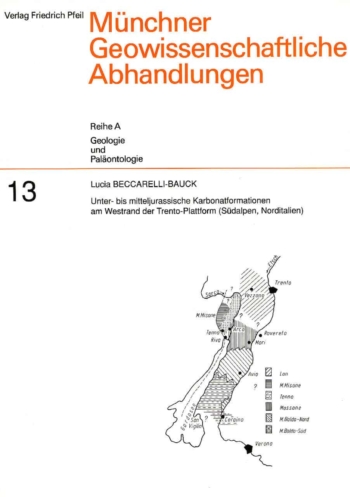
  • Unter- bis mitteljurassische Karbonatformationen am Westrand der Trento-Plattform (Südalpen, Norditalien)

    30,00 €

    zzgl. Versandkosten / Versandkostenfrei in D

Wir sind gerne für Sie da

Verlag Dr. Friedrich Pfeil
Hauptstraße 12B
5232 Bergkirchen OT Günding – Germany

Tel.: +49 8131 61 46 590
Fax: +49 8131 61 46 591
E-Mail: info@pfeil-verlag.de

Hauptstraße 12B - 85232 Bergkirchen OT Günding - Germany - Tel.: +49 8131 61 46 590 - Fax: +49 8131 61 46 591 - E-Mail: info@pfeil-verlag.de
© 2023 Verlag Dr. Friedrich Pfeil - Alle Rechte vorbehalten - Kontakt - Impressum - Datenschutzerklärung
Nach oben scrollen Nach oben scrollen Nach oben scrollen

Unsere Webseite verwendet erforderliche Cookies. Durch das Akzeptieren dieser Cookies sorgen Sie dafür, dass bei Ihrem Besuch alle Services sicher, stabil und reibungslos funktionieren. Die Verarbeitung Ihrer Daten erfolgt in Übereinstimmung mit unseren Datenschutz-Richtlinien

AkzeptierenNur essentielle CookiesEinstellungen

Cookies und Datenschutz-Einstellungen


Was sind Cookies?

Auf unserer Website verwenden wir sogenannte Cookies. Bei Cookies handelt es sich um Textdateien, die im Internetbrowser bzw. vom Internetbrowser auf dem Computersystem des Nutzers gespeichert werden, sobald ein Nutzer unsere Website aufruft. Cookies enthalten charakteristische Zeichenfolgen, die eine eindeutige Identifizierung des Browsers beim erneuten Aufrufen der Website ermöglichen.

Wir setzen Cookies ein, um unsere Website nutzerfreundlicher und sicher zu gestalten. Einige Seitenelemente unserer Website machen es erforderlich, dass der aufrufende Internetbrowser auch nach einem Seitenwechsel innerhalb unserer Website identifiziert werden kann.

Notwendige Cookies

Der Zweck der Verwendung technisch notwendiger Cookies ist es, die Nutzung von Websites für die Nutzer zu vereinfachen. Einige Funktionen unserer Internetseite können ohne den Einsatz von Cookies nicht angeboten werden. Für diese ist es erforderlich, dass der Internetbrowser auch nach einem Seitenwechsel wiedererkannt wird. In diesen technisch notwendigen Cookies werden Daten erhoben, gespeichert und an uns übermittelt, um den Abruf unserer Website aus der Datenbank zu ermöglichen.

Web Analytics

Wir setzen keinerlei fremde Dienste zur Analyse Ihres Surfverhaltens ein.

Unser Hostingprovider wertet von Zeit zu Zeit die erfolgten Zugriffe mithilfe von Werkzeugen aus, die auf die ohnehin anfallenden Serverlogfiles zugreifen. Diese Auswertung erfolgt ausschließlich anonymisiert und dient lediglich der Optimierung unserer Webdienste und der Server selbst.

Andere externe Dienste

Wir verwenden verschiedene externe Dienste wie z.B. Bayernatlas. Deren Anbieter sammeln möglicherweise personenbezogene Daten wie Ihre IP-Adresse.

Datenschutzerklärung

Wir bemühen uns, eine einfache und gut beschriebene Datenschutzerklärung bereitzustellen. Wir finden Datenschutz äußerst wichtig und wollen genau erklären, wie sorgsam wir mit Ihren Daten umgehen. Unsere Datenschutzerklärung finden Sie hier:

Datenschutzerklärung
AkzeptierenNur essentielle