• German
  • English
  • Warenkorb
  • Login/Benutzerkonto
Verlag Dr. Friedrich Pfeil
  • [avia_search]
  • Shop
    • Login/Benutzerkonto
  • Gesamtverzeichnis
  • Archäologie
    • Bücher
    • Reihen & Zeitschriften
    • Blickpunkt Archäologie
  • Biologie
    • Bücher
    • Reihen & Zeitschriften
    • Ichthyological Exploration of Freshwaters
    • Meiofauna Marina
  • Geographie
    • Bücher
    • Reihen & Zeitschriften
  • Geologie
    • Bücher
    • Kinderbücher Geologie
    • Reihen & Zeitschriften
    • Wanderungen in die Erdgeschichte
    • Münchner Geowissenschaftliche Abhandlungen Reihe B
  • Ökologie
  • Paläontologie
    • Bücher
    • Reihen & Zeitschriften
    • Münchner Geowissenschaftliche Abhandlungen Reihe A
    • Handbook of Paleoichthyology
  • Sonstiges
    • Philosophie
    • Romane
    • Volkskunde
  • E-Book (PDF) Bestellungen
  • Verlag
  • Buchhandel
  • Für Autoren
  • Kontakt
  • Menü Menü
  • Einkaufswagen Einkaufswagen
    0Einkaufswagen
  • Link zu Facebook
  • Link zu X

Suche

Search Search
Blick ins Buch:
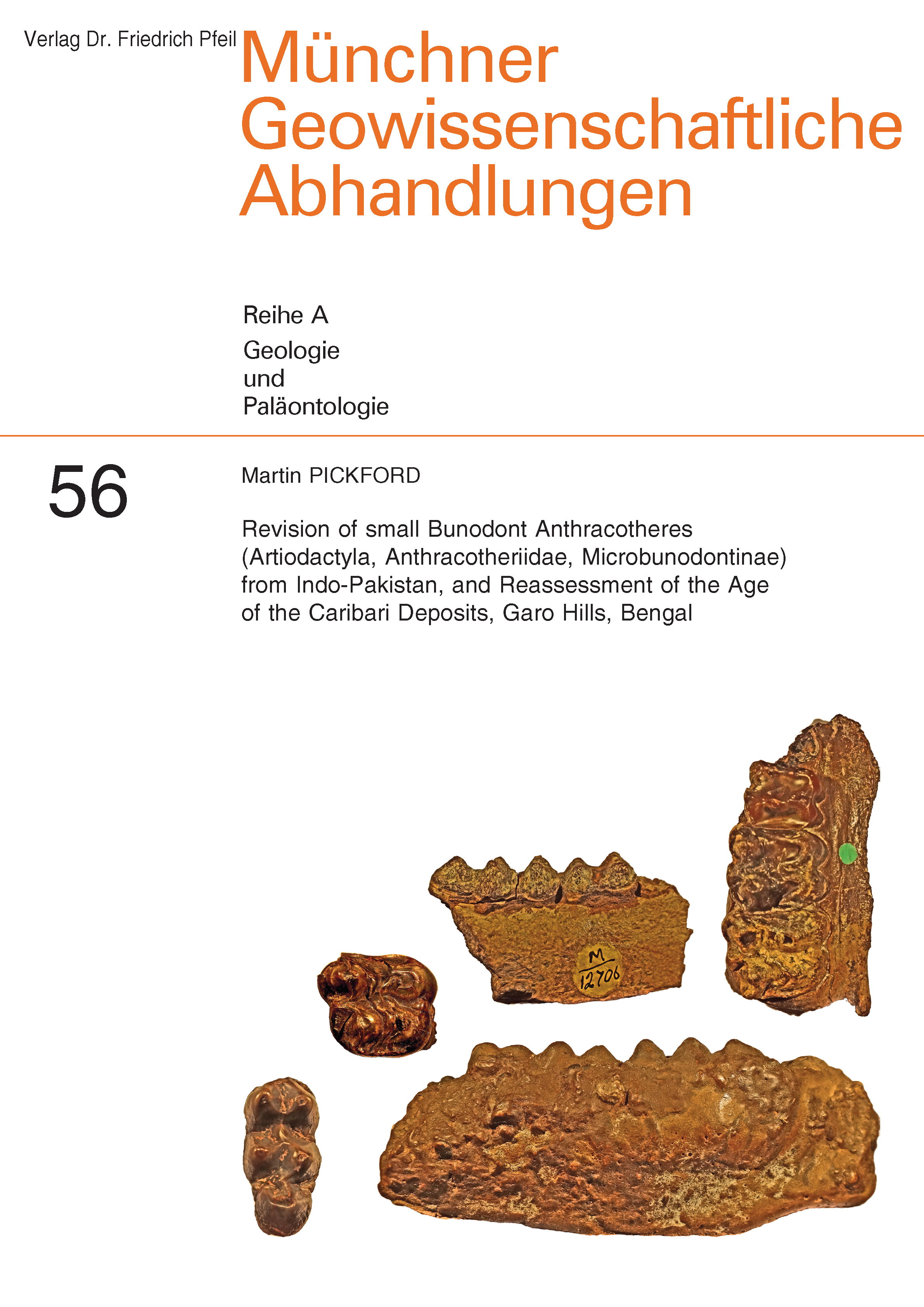
PICKFORD, Martin

Revision of small Bunodont Anthracotheres (Artiodactyla, Anthracotheriidae, Microbunodontinae) from Indo-Pakistan, and Reassessment of the Age of the Caribari Deposits, Garo Hills, Bengal

Münchner Geowissenschaftliche Abhandlungen - Reihe A
Band: 56

2026. [Englisch] – 40 Seiten, 22 Farb- und 5 Schwarzweißabbildungen, 1 Annex.
29,7 x 21,0 cm, Paperback.

Reihe: MGA, Reihe A: Geologie und Paläontologie

Vorbestellung. Dieses Buch erscheint im März 2025.

ISBN: 978-3-89937-313-4
ISSN: 0177-0950
Artikelnummer: 9783899373134 Kategorie: Paläontologie Schlagwort: Münchner Geowissenschaftliche Abhandlungen - Reihe A

45,00 €

zzgl. Versandkosten / Versandkostenfrei in D

  • Zusammenfassung
  • Inhaltsverzeichnis
  • Vorwort
  • Kundenmeinungen
  • Rezensionsexemplar

A small species of bunodont anthracothere from the basal Late Miocene of Dhok Mila, Pakistan (Nagri Formation) was named Microbunodon milaensis Lihoreau, Blondel, Barry & Brunet, 2004. The hypodigm of the species included two specimens reported as being from unknown localities. Further investigation has elucidated the localities from which the two specimens came. One is from Caribari (Garo Hills, Bengal, India), the other is from Chur Lando (Bugti region, Pakistan). The catalogue number of the fossil from Caribari was reported to be NHMUK M 19442, but it is in fact NHMUK PV OR 19042. The tooth, a right m/3, is compatible in dimensions and morphology with NHMUK PV OR 19041, the lectotype right M3/ of Anthracotherium silistrense Pentland, 1828, on which basis it is inferred that the two bunodont teeth from Caribari belong to a single species. The Caribari m/3 was included among the fossils attributed by the authors to Microbunodon milaensis. As such, Mb. milaensis becomes a junior synonym of A. silistrense. This conclusion prompts a revision of the small bunodont anthracotheres from Indo-Pakistan, an understanding of which requires an overview of the small anthracotheres from the Eocene and Oligocene of Europe and Southeast Asia (Myanmar, Thailand). It is demonstrated that the genus Microbunodon Depéret, 1908, does not occur therein. A new genus is erected for the small bunodont anthracotheres from Indo-Pakistan in which there are three time successive size groups interpreted to represent distinct species. The senior name for the the largest species is Gen. nov. silistrensis, the medium-sized species is Gen. nov. punjabiensis (Lydekker, 1877a) and the smallest species is Gen. nov. exiguus (Forster-Cooper, 1924). Caribari also yielded the type specimen (NHMUK PV OR 19040) of the small selenodont anthracothere, Sivameryx palaeindicus (Lydekker, 1877b). The presence of Gen. nov. silistrensis and S. palaeindicus at Caribari indicates that the Bengali deposits are most likely to correlate to the late Middle Miocene to basal Late Miocene (ca 12-9.5 Ma), rather than to the Early Miocene as thought for the past two centuries.

Key Words: Miocene, Indo-Pakistan, Anthracothere, Bunodont, Selenodont, taxonomy, phylogeny, biostratigraphy, biogeography
Introduction 7
Materials and methods 8
Dental nomenclature 8
Abbreviations 8

Taxonomic issues European Microbunodontinae 9
Small bunodont anthracotheres from the Oligo-Miocene of Europe 13
Metric analysis European Microbunodontinae 14
Genus Microbunodon Depéret, 1908 15
Genus Microselenodon Depéret, 1908 15
Species Microselenodon minimum (Cuvier, 1824) 15
Overview of the Microbunodontinae Lihoreau et Ducrocq 2007 16

Systematic descriptions 18
Genus Garobunodon nov. 18
Species Garobunodon silistrensis (Pentland, 1828) 18
Species Garobunodon punjabiensis (Lydekker, 1877a) 24
   Garobunodon exiguus (Forster-Cooper, 1924) 27
Metric analyses 30
Historical background 30
Metric analysis present study 31
Biostratigraphic implications 32
Palaeodiet 32
Phylogeny 33
Palaeobiogeography 33

General discussion 34

Conclusions 35

Acknowledgements 35

References 35

Annex 38

Dentognathic remains of small bunodont anthracotheres were first described from the Miocene continental deposits of Indo-Pakistan almost two centuries ago. At Caribari (Garo Hills, Bengal, sometimes spelled Karibari) the association of a bunodont species, at the time called Anthracotherium silistrense Pentland, 1828 (based on an isolated upper molar) with a selenodont form of similar dimensions, now known as Sivameryx palaeindicus (Lydekker, 1877b) (based on a maxilla with D3/ and D4/) was the root of a great deal of confusion (Forster-Cooper, 1924; Matthew, 1929; Colbert, 1935; Pickford, 1987). Recall that this species was named only four years after the naming of the genus Anthracotherium Cuvier, 1822 (1824).

A bunodont lower third molar of an anthracothere from Caribari presented to the NHMUK in 1842 as part of the Cautley collection, but that remained undescribed until recently (Lihoreau et al. 2004), throws a great deal of light on the taxonomy of the bunodont species, but when described by the latter authors its locality was said to be unknown, a conclusion undoubtedly due to the fact that its catalogue number was misread as NHMUK M 19442 instead of NHMUK PV OR 19042 (see below). Examination of the OR catalogue at the NHMUK indicates that the specimen was collected at Caribari, the same locality as two other anthracothere fossils (OR 19040, a maxilla of a juvenile selenodont anthracothere, and PV OR 19041, an isolated M3/ of a small bunodont anthracothere). The bunodont lower and upper third molars from Caribari are compatible with each other in morphology and dimensions, on which basis it is concluded that they represent a single species, in recent literature known as Microbunodon silistrensis.

Because of this discovery, the previous attribution of the Indo-Pakistan small bunodont anthracotheres to the genus Microbunodon requires re-assessment. The morphological differences concerning the mandibles of European Oligo-Miocene species and the Miocene ones from Indo-Pakistan evoked by Lihoreau et al. (2004), opens the possibility that there are two or more genera involved. The anterior parts of mandibles from Indo-Pakistan are scarce (Colbert, 1935; Lihoreau et al. 2004) and no skulls have been described, which hinders comparisons between them and the European forms.

Comparison of the augmented sample of Indo-Pakistan small bunodont anthracotheres with specimens from Europe reveals that they differ from Microbunodon Depéret, 1908, and Microselenodon Depéret, 1908, as suspected by Colbert (1935) who wrote that the Siwalik forms might be included in Microselenodon but because the latter genus was poorly defined it was better to leave the Indian fossils in Anthracotherium. The newly available samples from Europe (La Milloque) and Indo-Pakistan, especially the undescribed material from Ramnagar which was consulted on Morphosource (Patel et al. 2022), provide additional information that clarifies the affinities of the ‘Siwalik’ taxa.

The additional material from La Milloque, France (Brunet, 1968; Lihoreau et al. 2004) was for a long time included in Microbunodon minimum but, because Anthracotherium minimum is the type species of Microselenodon, and because it clearly differs in morphology and dimensions from the type species of Microbunodon (Mb. laharpei (Renevier, 1879)) the Milloque species should be classified in Microselenodon. The outcome, as suspected by Colbert (1935) is that the ‘Siwalik’ forms are not particularly close to Microselenodon, nor to Microbunodon, and they also differ sufficiently from Anthracotherium to necessitate the erection of a new genus, herein called Garobunodon, named for the Garo Hills from which the type species, previously known as Anthracotherium silistrense, was collected.

Metric analysis of the small bunodont anthracotheres from the Miocene deposits (Siwaliks, Bugti, Sind etc.) of Indo-Pakistan reveals the presence of three size groups, the largest one containing the holotypes of two species (Anthracotherium silistrense (Pentland, 1828) and Microbunodon milaensis Lihoreau, Blondel, Barry & Brunet, 2004), the medium-sized one containing the holotypes of two species, in the order of naming: Microbunodon punjabiensis (Lydekker, 1877a) and Microselenodon mus (Pilgrim, 1908) and the smallest group contains the lectotype of Anthracotherium exiguum Forster-Cooper, 1924. It is concluded that the valid names of the species representing the three size groups are: 1) Garobunodon silistrensis for the largest of the three species, 2) Garo­bunodon punjabiensis for the medium-sized species, and Garobunodon exiguus for the smallest of the three.

Concerning the age of the Caribari sedimentary deposits, the new interpretation of the fossils indicates that the association of two species of small anthracotheres (Garobunodon silistrensis and Sivameryx palaeindicus) in the Bengali deposits, accords best with an age estimate of Late Middle Miocene to basal Late Miocene (ca 12-9.5 Ma) instead of the traditional view that the deposits were of Early Miocene age.

Rezensionen

Es gibt noch keine Rezensionen.

Schreiben Sie die erste Rezension für „Revision of small Bunodont Anthracotheres (Artiodactyla, Anthracotheriidae, Microbunodontinae) from Indo-Pakistan, and Reassessment of the Age of the Caribari Deposits, Garo Hills, Bengal“ Antwort abbrechen

Sie müssen angemeldet sein, um eine Rezension veröffentlichen zu können.

„*“ zeigt erforderliche Felder an

Name*
E-Mail*
Anschrift*
Einwilligung*

Ähnliche Produkte

  • Die systematische Stellung der thalamiden Schwämme und ihre Bedeutung in der Erdgeschichte

    50,00 €

    zzgl. Versandkosten / Versandkostenfrei in D

  • Faziesanalyse und Untersuchungen der Sedimentationsmechanismen in der Unteren Brackwasser-Molasse Oberbayerns

    30,00 €

    zzgl. Versandkosten / Versandkostenfrei in D

  • Prionogale breviceps n. gen. n. sp. – Evidence of an unknown major clade of Eutherians in the Lower Miocene of East Africa

    50,00 €

    zzgl. Versandkosten / Versandkostenfrei in D

  • Faziesverteilung und Fossilvergesellschaftungen im karbonatischen Flachwasser-Milieu der alpinen Oberkreide (Gosau-Formation)

    45,00 €

    zzgl. Versandkosten / Versandkostenfrei in D

  • Zahnmorphologische Untersuchungen an rezenten und fossilen Haien

    40,00 €

    zzgl. Versandkosten / Versandkostenfrei in D

Wir sind gerne für Sie da

Verlag Dr. Friedrich Pfeil
Hauptstraße 12B
5232 Bergkirchen OT Günding – Germany

Tel.: +49 8131 61 46 590
Fax: +49 8131 61 46 591
E-Mail: info@pfeil-verlag.de

Hauptstraße 12B - 85232 Bergkirchen OT Günding - Germany - Tel.: +49 8131 61 46 590 - Fax: +49 8131 61 46 591 - E-Mail: info@pfeil-verlag.de
© 2023 Verlag Dr. Friedrich Pfeil - Alle Rechte vorbehalten - Kontakt - Impressum - Datenschutzerklärung
Nach oben scrollen Nach oben scrollen Nach oben scrollen

Unsere Webseite verwendet erforderliche Cookies. Durch das Akzeptieren dieser Cookies sorgen Sie dafür, dass bei Ihrem Besuch alle Services sicher, stabil und reibungslos funktionieren. Die Verarbeitung Ihrer Daten erfolgt in Übereinstimmung mit unseren Datenschutz-Richtlinien

AkzeptierenNur essentielle CookiesEinstellungen

Cookies und Datenschutz-Einstellungen


Was sind Cookies?

Auf unserer Website verwenden wir sogenannte Cookies. Bei Cookies handelt es sich um Textdateien, die im Internetbrowser bzw. vom Internetbrowser auf dem Computersystem des Nutzers gespeichert werden, sobald ein Nutzer unsere Website aufruft. Cookies enthalten charakteristische Zeichenfolgen, die eine eindeutige Identifizierung des Browsers beim erneuten Aufrufen der Website ermöglichen.

Wir setzen Cookies ein, um unsere Website nutzerfreundlicher und sicher zu gestalten. Einige Seitenelemente unserer Website machen es erforderlich, dass der aufrufende Internetbrowser auch nach einem Seitenwechsel innerhalb unserer Website identifiziert werden kann.

Notwendige Cookies

Der Zweck der Verwendung technisch notwendiger Cookies ist es, die Nutzung von Websites für die Nutzer zu vereinfachen. Einige Funktionen unserer Internetseite können ohne den Einsatz von Cookies nicht angeboten werden. Für diese ist es erforderlich, dass der Internetbrowser auch nach einem Seitenwechsel wiedererkannt wird. In diesen technisch notwendigen Cookies werden Daten erhoben, gespeichert und an uns übermittelt, um den Abruf unserer Website aus der Datenbank zu ermöglichen.

Web Analytics

Wir setzen keinerlei fremde Dienste zur Analyse Ihres Surfverhaltens ein.

Unser Hostingprovider wertet von Zeit zu Zeit die erfolgten Zugriffe mithilfe von Werkzeugen aus, die auf die ohnehin anfallenden Serverlogfiles zugreifen. Diese Auswertung erfolgt ausschließlich anonymisiert und dient lediglich der Optimierung unserer Webdienste und der Server selbst.

Andere externe Dienste

Wir verwenden verschiedene externe Dienste wie z.B. Bayernatlas. Deren Anbieter sammeln möglicherweise personenbezogene Daten wie Ihre IP-Adresse.

Datenschutzerklärung

Wir bemühen uns, eine einfache und gut beschriebene Datenschutzerklärung bereitzustellen. Wir finden Datenschutz äußerst wichtig und wollen genau erklären, wie sorgsam wir mit Ihren Daten umgehen. Unsere Datenschutzerklärung finden Sie hier:

Datenschutzerklärung
AkzeptierenNur essentielle