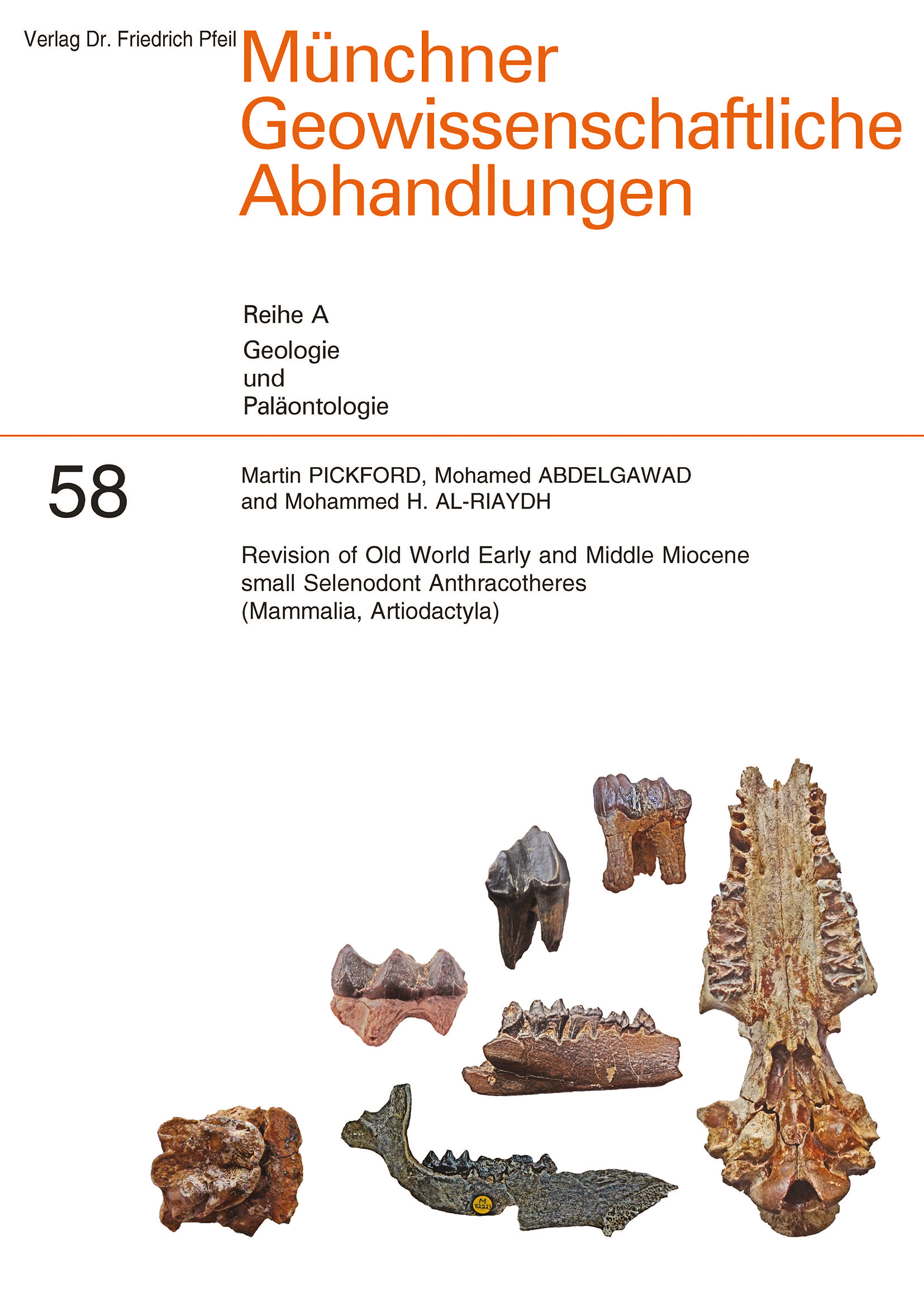


This monograph presents the first comprehensive revision of the Early Miocene small anthracotheres of Africa and places them within a broader evolutionary and biogeographical framework by integrating evidence from the Middle East, the Indian Subcontinent and Europe. Based on extensive re-examination of historical collections together with newly discovered and previously undescribed fossil material from Moghara (Egypt) and Gebel Zelten (Libya), the study provides a fundamental reassessment of the taxonomy, systematics and diversity of these poorly understood artiodactyls.
For more than a century, many African small anthracothere fossils were referred to a limited number of taxa, particularly Sivameryx moneyi and Sivameryx africanus. Detailed analyses of cranial, mandibular and dental morphology presented in this volume demonstrate that these traditional assignments considerably underestimated the true diversity of the group. Comparative study of material from Africa, Pakistan, India, the Levant and Europe reveals that several previously recognised species represent distinct evolutionary lineages, necessitating extensive taxonomic revision.
The monograph resurrects the genus Merycops as distinct from Sivameryx and establishes the new genera Prolibycosaurus, Maradameryx, Afromerycops and Libycomeryx. It further reassesses the status of Afromeryx, Nacholameryx and other problematic taxa, providing revised diagnoses, systematic relationships and distributional data. The resulting classification recognises a substantially greater diversity of small anthracotheres in the African Neogene than previously appreciated, with at least eleven genera now documented from the Early Miocene of Africa.
Beyond its taxonomic contributions, the study offers important insights into the evolutionary history and palaeobiogeography of anthracotheres. It documents faunal connections between Africa, the Arabian Peninsula, the Indian Subcontinent and parts of Europe, while highlighting regional diversification and evolutionary innovation within the African record. The revised phylogenetic framework provides a more robust basis for interpreting dispersal patterns, lineage evolution and faunal exchange across the Old World during the Neogene.
Combining detailed systematic descriptions, comprehensive comparative analyses and high-quality illustrations of fossil specimens, this volume represents the most complete treatment of African small anthracotheres published to date. It provides an essential reference for vertebrate palaeontologists, mammalian taxonomists, evolutionary biologists and researchers interested in Neogene mammalian faunas and Old World biogeography.
By providing a revised systematic framework for one of the least understood groups of Old World anthracotheres, this monograph establishes a taxonomic foundation for future studies of Neogene mammalian evolution, palaeoecology and biogeography.






Reviews
There are no reviews yet.