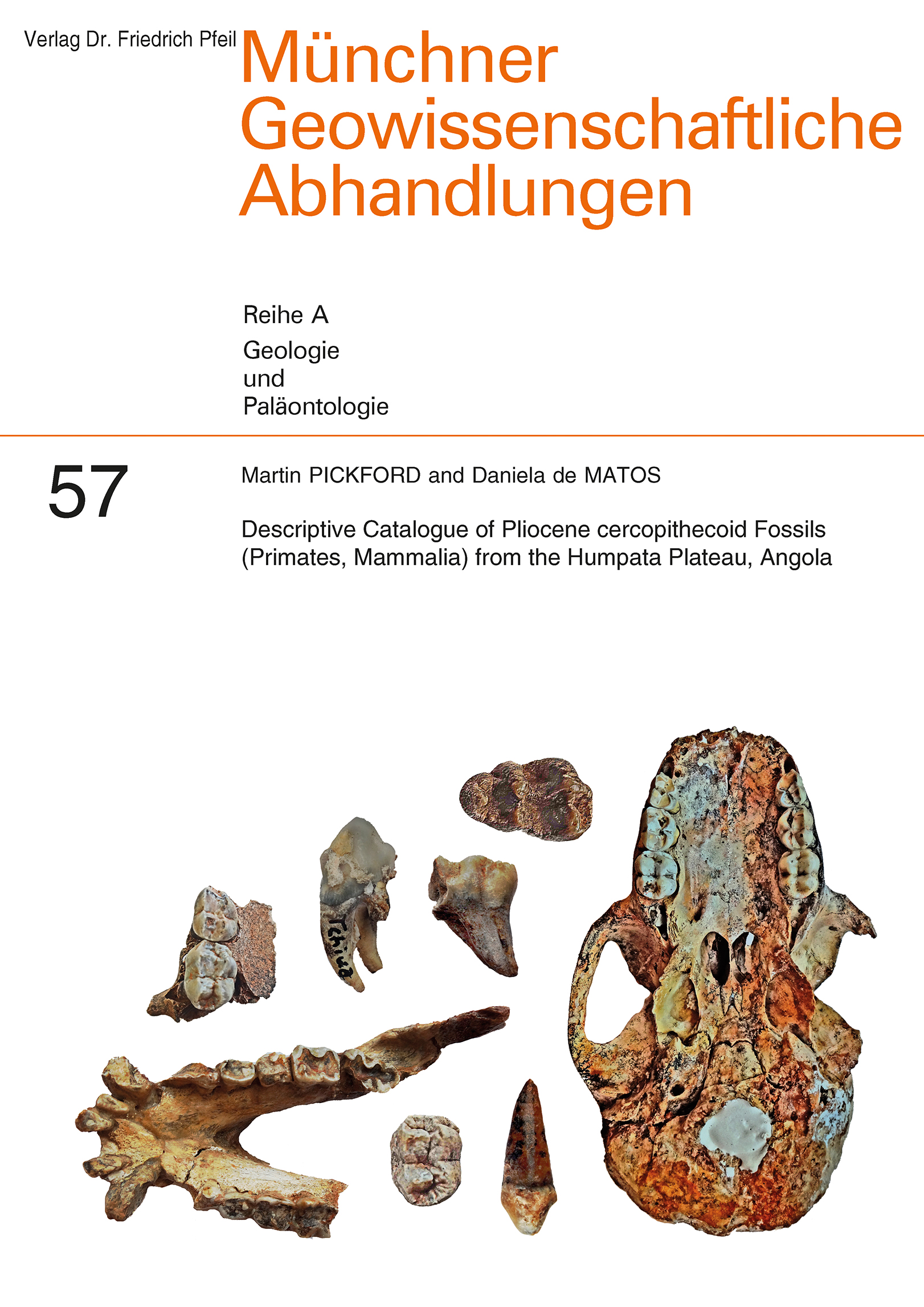


Cercopithecid fossils were first collected from the Plio-Pleistocene karstic infillings of the Humpata Plateau, southern Angola, in the 1940’s. Further collections were made during the 1950s by F. Mouta and by J. Camarate-França, but only a few of the more complete cranial specimens were published by C. Arambourg and F. Mouta and later revised by E. Delson, C. Gilbert and other researchers. In the collections made by Camarate-França, there are more than 100 isolated teeth and many postcranial elements that have never been described, possibly because of the untimely death of the latter researcher who was undertaking his thesis studies on them. The materials are curated by the Museum of Natural History and Science of the University of Lisbon, and the collection is currently deposited at Centre for Archaeology (UNIARQ). There are several cercopithecid specimens curated at the Museu Regional de Huila, in Lubango, Angola, but they have not been freed from their breccia matrix and remain unstudied. Additional monkey specimens were collected from the region in 1989 and 1990 by the Angola Palaeontology Expedition, some of which were published by N. Jablonski, with subsequent revisions by E Delson, C. Gilbert and other researchers.
The present publication illustrates and provides succinct descriptions of many of the accessible cercopithecid dentognathic fossils from the Quaternary of Angola, and provides measurements and taxonomic identifications, so that researchers can access the data for their own studies.
The currently available collections of fossils from Angola indicate that there are at least three, possibly four, geochronological assemblages in the region, one from Tchiua which is basal to middle Pliocene in age, the second from Cangalongue which exhibits somewhat younger affinities within the Pliocene (Fig. 5), the third from Malola, of Late Pliocene age, and a fourth assemblage, with few if any primate fossils in association with Middle Stone Age tools at Leba Cave (not treated in this catalogue, but mentioned briefly by Gautier, 1995) but most of the primate material listed by the latter author is from Tchiua, not the Leba Cave.
The Tchiua cercopithecid assemblage comprises three taxa: one large species of colobine and two papionines, one related to mandrills or baboons, the other to geladas, whereas the Cangalongue assemblage currently consists of a single small species of Theropithecus. The cercopithecid fossils from Ufefua and Malola are unidentifiable fragments. The possible presence of a mandrill-like cercopithecid in the middle Pliocene of Angola is potentially of great interest, not only because it would be among the earliest known members of the clade, but also because it occurs well outside the present-day range of distribution of extant mandrills.
Key Words: Colobines, Mandrills, Baboons, Geladas, Pliocene, Biogeography, Biostratigraphy, Southern Africa


Reviews
There are no reviews yet.